
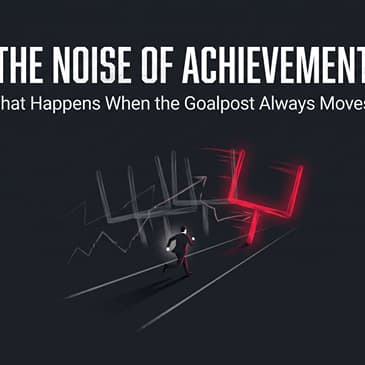
Your life finally goes quiet and instead of relief, you feel a tight chest and a compulsive need to “fix” something. We know that feeling, and we go straight at it: what if the thing you call ambition is sometimes just fear of stillness?
We unpack why achievement can act like anesthetic. The rush of goals, metrics, and nonstop motion can drown out what shows up when the room gets silent, like resentment you never named, loneliness you’ve normalized, or the creeping suspicion that your career path doesn’t fit anymore. We connect the dots between hustle culture and experiential avoidance, and we explain how an overstimulated nervous system learns to treat silence like danger. When the noise stops, the brain screams that something must be wrong, even when nothing is.
A story about a high-achieving VP on a no-Wi‑Fi cabin trip makes it painfully clear: remove the emails and the performance, and an identity crisis walks in. So we end with a simple, practical reset you can try within 24 hours, a five-minute stillness microhabit that builds tolerance for quiet without forcing you to quit your job or “become a different person.”
If this hits close to home, listen, share it with the friend who can’t sit still, and leave a review so more people can find the conversation. What do you notice when you stop running?
The Monster In The Empty Room
WesIt's Sunday, 4 p.m., the laundry's done, the groceries are put away, the emails you really needed to answer are sent. Your partner is reading, the dog asleep, and the kids, they're not being monsters at the moment. You sit down on the couch, you pick up your phone, you put it down, you pick up the TV room, you scroll through Netflix for five minutes, you put it down. Then it happens. That little tightening in your chest, I think, was in your jaw. You think maybe I'll start that side of the room. Maybe I'll go for a run. Maybe I should reorganize the garage. Why? Because sitting there in the quiet for more than 60 seconds feels dangerous. It feels like you're falling behind. It feels like you're wasting your life. You call it ambition. You call it driver. You tell yourself you're just a go-getter. But what if you're you're not running towards success? What if you're just running away from the quiet? Welcome to the According to West Podcast. Today we're talking about the monster in the empty room and why your ambition might just be a fear of stillness. Now look, I know what you're thinking. You're thinking, come on, I'm just motivated. I have goals. I want to build a good life for my family. Are you really telling me that wanting a promotion or starting a business means I have some deep psychological flaw? Nope. That's that's not what I'm saying at all. But uh I want you to be really honest with yourself for a second. When you get that promotion, how long does it how long does that satisfaction last? A week? A day? Ten minutes? And then what happens? You immediately look for the next mountain to climb, the next target, the next thing to fix. It's like you're on a treadmill that you control, but you're terrified to press the stop button. You tell yourself, I'll relax when I hit this financial goal, or I'll take a break when this project launches. But you know, deep down that's a lie. Because the moment you hit that goal, the goalpost moves. We all do it. You're not addicted to achievement, you're you're addicted to the noise of achievement because the noise drowns out whatever is waiting for you when the room gets quiet. Let's break down what's actually happening in your brain when you try to sit still. We humans evolved to solve problems. If there
The Treadmill You Fear Stopping
Weswas a rustle in the bushes, our ancestors needed to act. Silence meant safety, but in our modern world, we completely flipped the script. We are so overstimulated by notifications, news cycles, the constant pressure to optimize every second of our lives. Wondering if we all like GTA 6. You know, we worry about these things that are to the point that our nervous systems are stuck in problem-solving mode. And when you finally stop, when you take away the phone, the work, the podcast, not this podcast, or GTA 6. We know you won't. Your brain goes into withdrawal. It says, wait, we aren't solving a problem. Something must be wrong. But there's a deeper layer here. It's not just biological, it's emotional. You know, stillness,
Stillness As A Mirror
Wesstillness is a mirror. When you are busy, you don't have to feel. You don't have to think about the lingering resentment towards your parents, you don't have to face the fact that your marriage feels a little lonely. You don't have to confront the terrifying thought that maybe, just maybe, you don't actually like the career you spent 10 years building. So, ambition, the endless pursuit of more, is the perfect, socially accepted and aesthetic. If you drink too much to numb your feelings, people stage an intervention. But if you work 80 hours a week to numb your feelings, people give you an award. They call you a visionary, they they put you on the cover of magazines. We use hustle as a shield against intimacy with ourselves. Psychologists call this experiential avoidance. It's the attempt to avoid unpleasant thoughts, feelings, or sensations. And what better way to avoid them than by filling every waking moment with tasks, goals, and metrics. Think about the concept of productive procrastination. You know you need to have a difficult conversation with a friend. So instead, you spend three hours color-coding your spreadsheet. You feel like you did something valuable, but you completely avoided the actual discomfort. That's what toxic ambition is. Avoiding the one thing you really need to do, which is sit with yourself.
David’s Cabin And Identity Panic
WesLet's look at how this plays out in the real world. Let's uh for an example, let's talk about a guy named David. David is uh is your classic high achiever. He's he's 35, he's a VP at a tech firm, he drives a nice car, he runs marathons. Uh to the outside to the outside world, David is he's crushing it, he's doing his thing. Like all the guys want to be him, all the girls want to fuck him. But David's wife recently suggested that they take a two-week vacation to a remote cabin, which means no Wi-Fi, just them, a fireplace, and some books. David agreed, thinking it sounded relaxing. On day one, David chops wood, he organizes the pantry, he reads three chapters of a business book. On day two, David starts to feel irritable. He paces around the cabin, he complains that the coffee is bad, and on day three, David suggests that they cut the trip short because he suddenly remembered a crucial project he needs to oversee. Sounds like David is lying. But, you know, why did David panic? Because the cabin took away his shield. Without his emails, his meetings, and his marathon training schedule, David was left alone with David. And goodness forbid, David has to sit with David. And in that quiet, a thought started to creep in. A thought he had been suppressing for five years. I don't know who I am without my job. If David isn't a the VP or the marathoner, who is he? The stillness forced him to confront an identity crisis he's been outrunning since his twenties. So he fled back to that noise. He went back to the office, he manufactured a crisis to solve. And all that felt familiar. It felt comforting. He told his colleagues he came back early because he's just too dedicated to the company. They praised him. The anaesthetic worked, but the underlying infection, that fundamental disconnection from himself, it's still there, growing in the dark. We all have that version of David's cabin. Maybe it's a Sunday afternoon, maybe it's a long flight with our Wi-Fi. Maybe it's the quiet hour after the kids go to bed. What happens when you are forced into the cabin? Do you try to escape? Or do you sit by the fire and introduce yourself to whoever is sitting there with you? So, how do we fix this?
Five Minutes Of Silence Practice
WesDo we all need to quit our jobs and move to Tibet? No. Ambition is it's not a bad thing. Wanting to build, create, and achieve is a beautiful part of the human experience. But you need to you need to be driving the ambition, not the other way around. You need to know that you are turning toward a meaningful goal, not just running away from the quiet. To do that, you have to build a tolerance of stillness. You have to train your brain to realize that silence is not a threat. Here's your one actionable microhabit for the next 24 hours. Sometime tomorrow, I want you to set a timer on your phone for exactly five minutes. Put that phone in another room, sit in a chair, no music, no podcast, no book, no laptop. Just you, a chair, and five minutes. Notice what happens. Notice the urge to get up. Notice the phantom buzz in your pocket. Notice the thoughts that rush in to fill the empty space. Don't fight them, just watch them. Say to yourself, I am safe. There is nothing I need to solve right now. Five minutes. It will feel like an hour the first time you do it. But it is the most important five minutes of your day because it's the only time you aren't performing for anyone. Not even yourself. Until next time, stop running. Sit down and see what happens.